

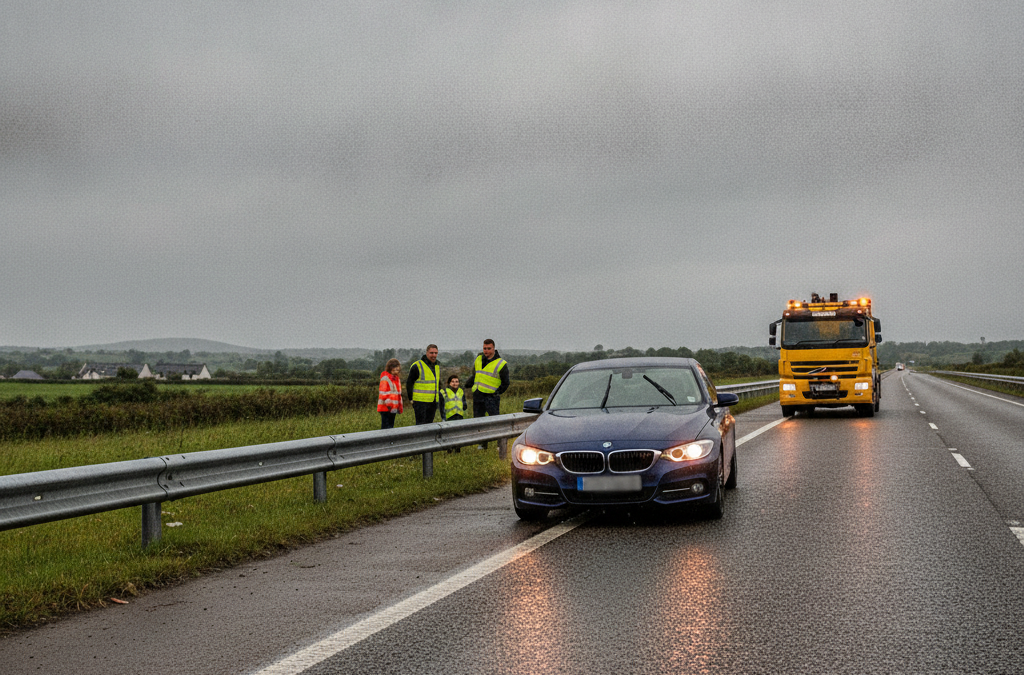
A breakdown on a motorway is one of the most stressful situations an Irish driver can face. Traffic is moving fast, heavy goods vehicles may be passing within metres, and a small mistake on the hard shoulder can quickly become dangerous. Whether you are on the M50, M1, M7, M8, N40, or another high-speed dual carriageway, the safest approach is always the same: get out of live traffic if you can, get people to a safe place, make yourself visible, and call for professional help.
This guide explains what to do if your vehicle breaks down on an Irish motorway or dual carriageway, with a focus on hard shoulder safety, emergency phones, location markers, calling roadside assistance, and avoiding risky DIY repairs. It is written for everyday drivers: commuters, families, new drivers, van drivers, and anyone who wants a clear plan before an emergency happens.
Motorways and national roads carry a significant share of Irish traffic. Transport Infrastructure Ireland outlines the scale of the national road network and the role of control and maintenance operations in keeping major roads moving. For drivers, the practical takeaway is simple: motorway breakdowns must be handled quickly, calmly, and safely because the road environment is unforgiving.
First rule: protect people before protecting the vehicle
When a car loses power, suffers a puncture, overheats, or displays a serious warning light, many drivers instinctively think about the vehicle first. On a motorway, that is the wrong priority. Your car can be recovered or repaired. You and your passengers need to move away from danger.
If you suspect something is wrong, do not brake sharply unless you must. Check your mirrors, indicate left, and move gradually towards the hard shoulder or a safe stopping area. Avoid stopping on a bend, in a lane, in a hatched area, or beside a narrow barrier if you have any alternative. If the vehicle is still moving, your goal is to leave the live lane and stop as far left as possible.
Once stopped, apply the handbrake or parking brake, switch on your hazard warning lights, and if visibility is poor use sidelights as well. Turn the wheels to the left where possible. This can help reduce the risk of the vehicle rolling back into traffic if it is struck or if the brake fails.
Using the hard shoulder correctly
The hard shoulder is not a parking place, a phone-call area, or somewhere to check a map. It is for emergencies, breakdowns, and certain authorised vehicles. If your vehicle is genuinely in difficulty, the hard shoulder can give you a vital buffer from live traffic, but it is still a high-risk place.
Stop as far left as safely possible
When you reach the hard shoulder, try to place the car close to the verge or barrier side, while still leaving enough room for passengers to exit on the left. Do not stop half in the hard shoulder and half in the driving lane. If you cannot reach the hard shoulder and the vehicle stops in a live lane, treat it as an immediate emergency and call 999 or 112 as soon as it is safe to do so.
On some dual carriageways, the shoulder may be narrow, intermittent, or absent. On slip roads and junction areas, traffic may merge unexpectedly. Do not assume other drivers can see you in time. Positioning and visibility matter, but getting people behind a barrier is usually more important than trying to make the car perfect.
Do not sit in the car unless there is no safer option
In many motorway breakdowns, the safest place is outside the vehicle, behind the safety barrier and well away from traffic. Leave by the passenger side if possible. Drivers should avoid opening the door into traffic. Passengers should move calmly and quickly, staying away from the carriageway.
If you have children, elderly passengers, or someone with reduced mobility, focus on moving them safely rather than rushing. Keep everyone together behind the barrier. If there is no barrier, move up the embankment or as far from the road as practical. Never stand between your vehicle and oncoming traffic.
Step-by-step: what to do after stopping
The following sequence is a practical motorway breakdown plan. It is worth remembering before you need it.
- Indicate left and move to the hard shoulder or safest available place.
- Stop as far left as possible, apply the parking brake, and turn on hazard lights.
- Turn the wheels left if safe to do so.
- Exit by the left-hand side where possible.
- Move all passengers behind the barrier or well away from traffic.
- Use a hi-vis vest if you have one, but do not delay leaving the vehicle to search for it.
- Identify your location using signs, marker posts, GPS, junction numbers, or nearby landmarks.
- Call emergency services first if anyone is injured, the vehicle is in a live lane, or there is an immediate danger.
- Call breakdown assistance or a recovery service once everyone is safe.
- Stay away from the vehicle until professional help arrives, unless instructed otherwise by emergency services.
This order matters. Calling for help while sitting in the driver seat beside fast traffic can put you at unnecessary risk. If the car is on the hard shoulder and can be left safely, move first, then make calls from a protected position.
When to call 999 or 112
Not every breakdown requires the emergency services, but some situations do. Call 999 or 112 immediately if your vehicle is stopped in a live lane, if there has been a collision, if someone is injured, if smoke or fire is present, if debris is blocking traffic, or if you feel you are in immediate danger.
You should also call emergency services if you break down in a tunnel, on a bridge, in very poor visibility, or in a location where other drivers may not be able to react. The same applies if you are carrying vulnerable passengers and cannot move them to safety.
Road safety enforcement and traffic response are part of the wider safety environment on Irish roads. The Garda Roads Policing section explains the Garda focus on road safety and community protection. In a breakdown emergency, do not hesitate to contact 999 or 112 if the situation could endanger life.
How to give your location on an Irish motorway
One of the biggest delays in motorway recovery is unclear location information. Telling a recovery operator that you are on the motorway near Dublin, Cork, Limerick, Galway, or Waterford is not enough. The more precise you can be, the faster help can find you.
Use junction numbers and direction of travel
Start with the road number and direction. For example: M7 southbound, between Junction 10 and Junction 11, on the hard shoulder. Or: M50 northbound, after the Ballymun exit, before the next junction. Direction matters because the recovery vehicle may need to approach from the correct carriageway.
If you recently passed a junction, toll, service area, bridge, or major sign, mention it. If you can safely see an overhead sign or distance board from behind the barrier, use that too. Do not walk along the hard shoulder to search for information unless instructed by emergency services and it is clearly safe.
Use marker posts and roadside reference points
Motorways and major roads often have roadside marker posts or reference points. These can help identify your position more accurately. If there is an emergency phone nearby, it may connect you to a control centre and may help identify where you are. If walking to an emergency phone would put you near live traffic, prioritise your safety and use your mobile phone from behind the barrier instead.
Use your phone location carefully
Smartphone maps can be useful, but do not stand beside traffic staring at your screen. Once you are in a safer place, open your map app and check the road, direction, nearby junctions, and the blue location dot. You may be able to share your live location with your recovery provider. If mobile signal is poor, a text message with your location may sometimes send more easily than a call.
Calling breakdown assistance: what to say
When you call for motorway breakdown assistance, be ready to give clear information. A calm, structured call helps the recovery operator choose the right vehicle and response.
- Your name and mobile number.
- Vehicle make, model, colour, and registration.
- Road number, direction of travel, junctions, and exact location clues.
- Whether the vehicle is on the hard shoulder, in a live lane, on a slip road, or in another position.
- How many passengers are present and whether anyone is vulnerable.
- The suspected fault, such as puncture, flat battery, overheating, warning lights, fuel issue, clutch failure, or accident damage.
- Whether the vehicle can roll, steer, and brake.
- Whether you need towing, roadside assistance, or transport to a garage or safe destination.
If you drive an older vehicle or a used car with unknown service history, preparation is especially important. Our guide to breakdown assistance for used cars and older vehicles in Ireland explains common age-related problems such as weak batteries, cooling system faults, and tyre issues that can become serious on long motorway journeys.
Why DIY repairs on the hard shoulder are rarely worth the risk
It is tempting to open the bonnet, change a wheel, add coolant, or investigate a noise. On a quiet local road, that may sometimes be reasonable. On a motorway hard shoulder, DIY repairs are usually too dangerous. Vehicles can drift, drivers can be distracted, and the speed difference between stopped traffic and moving traffic is severe.
Changing a tyre beside motorway traffic is a particular risk. Even if you have a spare wheel and jack, you may need to work on the traffic side of the car. A small slip, a gust from a passing lorry, or a vehicle crossing the edge line can put you in harm’s way. In most motorway puncture situations, the safer choice is to call professional recovery and wait behind the barrier.
Likewise, do not stand at the front of the vehicle with the bonnet up while traffic passes. If your car is overheating, smoking, or showing oil pressure warnings, move away and call for assistance. A car can be replaced; a person cannot.
What if you break down on a dual carriageway?
Dual carriageways can feel less intimidating than motorways, but they can be just as dangerous. Speeds may still be high, slip roads may be short, and hard shoulders may vary. Treat a breakdown on a high-speed dual carriageway with the same seriousness as a motorway breakdown.
If there is a hard shoulder, use it only if you can reach it safely. If there is a lay-by or service area nearby and the vehicle can still move safely, that may be better than stopping at the edge of traffic. However, do not continue driving a badly damaged, overheating, or unsafe vehicle in the hope of reaching a more convenient location. A seized engine, tyre blowout, or loss of steering can create a much worse situation.
Practical motorway breakdown examples
Example 1: sudden loss of power on the M7
You are travelling southbound on the M7 when the engine warning light flashes and the car loses power. You check mirrors, indicate left, and move steadily onto the hard shoulder. You stop well left, put on hazards, and move your passengers behind the barrier. From there, you call breakdown assistance and explain the road, direction, nearest junction, vehicle details, and that everyone is safe behind the barrier. You do not attempt to restart repeatedly or inspect the engine beside traffic.
Example 2: puncture on a busy dual carriageway
You feel vibration and hear tyre noise on a dual carriageway. You slow gently, avoid sudden steering, and stop in the safest available place. Although you have a spare wheel, the puncture is on the traffic side. Instead of changing it yourself, you leave the vehicle safely and call for recovery. This is often the correct decision because the risk of roadside tyre work near high-speed traffic is too high.
Example 3: older car overheating on a long journey
You are driving an older used car and notice the temperature gauge rising. You turn off unnecessary electrical loads, avoid hard acceleration, and look for a safe stopping place. Once stopped, you leave the vehicle and wait for help. You do not remove the coolant cap while hot. If your car is older or has had previous cooling problems, it is worth reading our advice on breakdown risks in older vehicles before your next long motorway drive.
What to keep in your car for safer motorway breakdowns
A small amount of preparation can make a breakdown safer and less stressful. Keep a charged phone, in-car charger, hi-vis vest, torch, warm jacket, water, and any important medication within reach. If you regularly carry children, consider blankets and snacks for delays. If you drive at night or in winter, a power bank is useful.
Before long journeys, check tyre pressure, tread condition, coolant level, oil level, lights, wipers, and fuel or charge level. For electric vehicles, plan charging stops and leave a buffer rather than aiming to arrive with minimal range. For diesel and petrol vehicles, avoid running close to empty on a motorway, especially late at night when services may be less convenient.
Drivers of used cars should pay extra attention to battery age, tyres, coolant hoses, belts, and warning lights. A minor fault around town can become a major breakdown after sustained motorway speeds. For more pre-journey advice, see our detailed guide on older vehicles and breakdown assistance.
What to do while waiting for recovery
After you have called for help, remain in the safest available place. Keep passengers behind the barrier, away from the vehicle and away from the carriageway. Stay alert. Do not wander along the hard shoulder, do not re-enter the vehicle for non-essential items, and do not let children or pets move freely.
If conditions change, call again. For example, if the vehicle begins smoking, if traffic is swerving around it, if a passenger becomes unwell, or if the car is struck, contact emergency services immediately. If your recovery provider asks for updated location information, provide it only when you can do so safely.
When the recovery operator arrives, follow instructions. They may position the recovery truck to protect the scene, ask you to remain behind the barrier, or move you to a safer location before loading the vehicle. Do not step onto the hard shoulder until they say it is safe.
Common mistakes to avoid
- Stopping on the hard shoulder for a non-emergency phone call or rest.
- Remaining seated in the vehicle when it is safer to stand behind the barrier.
- Standing between the car and traffic.
- Trying to change a tyre on the traffic side of the vehicle.
- Walking along the motorway to find a better signal or inspect damage.
- Using a warning triangle on a motorway where placing it would expose you to traffic.
- Giving vague location information such as near Dublin or after a toll without direction or junction details.
- Continuing to drive with severe warning lights, smoke, overheating, or tyre damage.
Conclusion: calm decisions save lives
A motorway breakdown in Ireland is never convenient, but a clear plan makes it safer. Move left if you can, stop as far from traffic as possible, switch on hazards, get everyone out on the safe side, and wait behind the barrier. If there is immediate danger, call 999 or 112. Once people are safe, contact breakdown assistance with accurate location details and avoid DIY repairs on the hard shoulder.
The most important point is to treat the hard shoulder as a danger zone, not a workspace. Professional recovery exists because high-speed roadside environments require the right equipment, training, and traffic awareness. Prepare before long journeys, know how to describe your location, and make people your first priority every time.